
The 9 phase of launch
Supporting Claims
1. S200 Ignition:Rocket boosters to launch LVM-3 Rocket.Imagine the S200 ignition as the "GO" button for a rocket. The S200 Solid Rocket Boosters (SRBs) are like powerful engines filled with solid fuel. When it's time to launch, we light up these SRBs together. They create a huge push that makes the rocket shoot upwards. This powerful push helps the rocket reach a height of about 0.024 kilometers. It's like the rocket's first big step into space. These boosters are essential to overcome the Earth's pull and start the exciting trip into the sky and beyond!
2.L110 is behind the another successful rocket launch of the GSLV Mark III (LVM3) carrying Chandrayaan 3 that reached an altitude of 44.668 km.The L110 is the second stage of the GSLV Mark III (LVM3), an advanced space launch vehicle developed by the Indian Space Research Organisation (ISRO). This particular stage plays a pivotal role in propelling the rocket and its payload to higher altitudes during the mission. The L110 is powered by two Vikas engines, each providing high thrust and efficiency.During the rocket launch, after the first stage (S200) separates, the L110 ignition occurs. This stage is crucial in further accelerating the rocket and propelling it towards its intended trajectory. The L110 uses liquid propellants, such as a combination of unsymmetrical dimethylhydrazine (UDMH) and nitrogen tetroxide (N2O4), which ensure efficient and controlled combustion, contributing to the rocket's ascent.The successful ignition of the L110 during the GSLV Mark III (LVM3) mission carrying Chandrayaan 3 was a significant milestone. This ignition marked a critical transition, pushing the rocket to an impressive altitude of 44.668 km. The altitude achieved is a testament to the precise engineering, rigorous planning, and seamless execution of the mission, showcasing India's advancements in space exploration.
3. The S200 separation and the burning phase of the L110 stage, along with the placement of the L110 in the rocket, are crucial aspects of the GSLV Mark III (LVM3) rocket launch.1. S200 Separation:The S200 is the first stage of GSLV Mark III and is composed of two large solid rocket boosters (SRBs) called S200. These boosters provide an immense initial thrust to the rocket at liftoff. After their solid fuel is depleted and they have fulfilled their purpose, they are jettisoned or separated from the rocket. This event, known as S200 separation, marks the end of the first stage and prepares for the ignition of the second stage, which is the L110.2. Burning Phase of L110: After the S200 separation, the L110 stage is ignited. The L110 is the second stage of GSLV Mark III and is powered by two Vikas engines, which utilize liquid propellants for propulsion. The burning phase involves the controlled combustion of these liquid propellants, typically a combination of unsymmetrical dimethylhydrazine (UDMH) as fuel and nitrogen tetroxide (N2O4) as an oxidizer. This controlled combustion generates high thrust and accelerates the rocket, propelling it to higher altitudes.3. Placement of L110: The L110 stage is situated above the S200 stage in the GSLV Mark III rocket. After the S200 separation, the L110 ignites and takes over as the second stage. It is strategically placed to continue the rocket's trajectory by providing the necessary propulsion to achieve the desired altitude and velocity for the mission's objectives.
4.Payload Fairing (PLF) Separation: Payload Fairing (PLF) separation is a pivotal event during a rocket's ascent into space. The payload fairing is a protective shell that encapsulates the payload (such as satellites, scientific instruments, or probes) housed within the rocket. Its purpose is to shield the payload from aerodynamic forces, friction, and other external environmental factors during the initial phase of the rocket's journey through the Earth's atmosphere.
Once the rocket surpasses the densest parts of the atmosphere and enters space, the aerodynamic stress diminishes significantly. At this point, the payload fairing is no longer necessary and becomes dead weight. To optimize the rocket's performance and reduce mass, the payload fairing is jettisoned or separated. This event typically occurs after the rocket has cleared the atmosphere.
Use and Location of PLF in the Rocket:The payload fairing is a crucial component positioned at the topmost part of the rocket. Its location is strategic, as it shields the payload during the rocket's ascent through the lower atmosphere. The fairing is composed of lightweight yet robust materials to withstand the stresses experienced during the initial phase of the launch.
The PLF is custom-designed and sized according to the payload it houses, ensuring a snug fit and optimal protection. As the rocket leaves the Earth's atmosphere and enters the vacuum of space, the fairing splits into halves or sections, peeling away from the payload and revealing it to the cosmos.
In summary, the PLF serves a vital role in safeguarding the payload during the rocket's ascent through Earth's atmosphere, and its timely separation enables the payload to fulfill its mission objectives in the space environment.
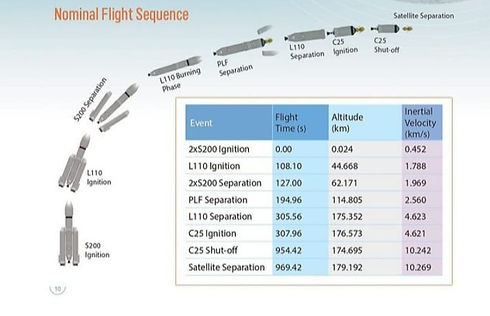
The Nine Phases of a Rocket's Journey
Background and Thesis
In the realm of space exploration, the launching of a rocket is a symphony of precision, engineering marvels, and human ingenuity. This extraordinary venture is orchestrated through a meticulously planned sequence of nine phases, each playing a crucial role in propelling the spacecraft from Earth's surface to the far reaches of the cosmos. These nine phases form the foundation of a rocket launch, an awe-inspiring odyssey that begins on the launch pad and concludes amidst the vast expanse of space.
The journey to the stars commences long before the roar of engines and the billowing of plumes, in a realm where careful planning and rigorous testing converge. As the world watches in anticipation, the countdown begins, marking the initiation of an epic odyssey into the cosmos. This countdown heralds the start of a meticulously choreographed spectacle, encompassing nine distinct phases that propel a rocket from its earthly abode to the endless celestial domains.
1. Pre-Launch Preparations: The genesis of this odyssey lies in meticulous pre-launch preparations. Engineers and scientists meticulously assemble the rocket, ensuring every component is in pristine condition. Payloads are integrated, systems are tested, and safety checks are conducted, all in the pursuit of a flawless launch.
2. Countdown and Ignition:The countdown is a symphony of anticipation, a rhythmic progression toward the moment of ignition. The world holds its breath as the countdown reaches its crescendo, igniting the engines and unleashing a surge of raw power that propels the rocket skyward.
3. Liftoff and Vertical Ascent:Liftoff, a moment of exhilaration and triumph, sees the rocket surge upward, defying gravity's grip. In the phase of vertical ascent, the rocket races through Earth's atmosphere, surging higher with each passing second, leaving the bonds of its home planet.
4. Stage Separations:The rocket is a marvel of engineering, composed of multiple stages, each with a specific purpose. As the rocket gains altitude, these stages are jettisoned, shedding weight and revealing the next phase of propulsion. Stage separations are a testament to engineering precision, enabling the rocket to accelerate towards its destination.
5. Orbital Insertion: Once free of Earth's atmosphere, the rocket maneuvers to achieve the desired orbit. Orbital insertion involves a carefully calculated alignment and velocity, crucial for the successful deployment of payloads or interplanetary missions.
6. Payload Deployment: For missions carrying satellites, scientific instruments, or exploratory probes, this phase involves the precise deployment of the payload into its intended orbit. It marks the fulfillment of a mission's primary objective.
7. Trajectory Correction and Adjustments: In this phase, the rocket may conduct trajectory corrections and adjustments, fine-tuning its path to ensure it adheres to its planned course, especially for interplanetary missions.
8. Arrival at Destinations: For missions beyond Earth orbit, this phase signifies the rocket's arrival at its celestial destination, whether it be another planet, moon, or interplanetary trajectory, marking a critical milestone in the journey.
9. Mission Completion and Objectives Achieved:The conclusion of the odyssey is marked by mission completion, where all primary and secondary objectives are achieved. Data is gathered, scientific discoveries are made, and the legacy of the mission is etched into the annals of human space exploration.
These nine phases represent a carefully orchestrated dance between human ambition and engineering expertise, culminating in a voyage of discovery and wonder into the cosmos, advancing our understanding of the universe and beckoning us to push further into the cosmic expanse.

C25 ignition and shut off
Supporting Claims
The events involving C-25 ignition and C-25 shutdown at specific altitudes are related to rocket propulsion stages. These are hypothetical events mentioned for illustrative purposes, as specific altitudes and ignition/shutdown sequences can vary based on rocket designs and missions.
1. C-25 Ignition:
Placement: C-25 ignition occurs in the third stage of the rocket, designated as C-25. This stage is typically located above the second stage (e.g., L110) and beneath any upper stages.
Use:C-25 is a liquid-fueled rocket stage, and its ignition is vital for further accelerating the rocket and propelling it to higher altitudes during the missionsNeed in the Rocket:C-25 provides the necessary thrust to overcome Earth's gravitational pull and atmospheric resistance, enabling the rocket to achieve the desired altitude for the mission's objectives.
Full Form:C-25 stands for "Cryogenic Stage 25," referring to the cryogenic propellants used in this rocket stage.
2. C-25 Shutdown:
Placement:C-25 shutdown occurs after the rocket has reached a specific altitude, typically at the end of the third stage of the rocket (C-25).
Use:The shutdown marks the conclusion of the C-25 stage's active propulsion, ceasing the injection of additional thrust.
Need in the Rocket:Shutting down C-25 is necessary to transition to subsequent stages, payloads, or maneuvers as required by the mission profile, optimizing fuel usage and trajectory. Full Form:C-25 Shutdown refers to the termination of propulsion for the Cryogenic Stage 25 in the rocket.

Satellites Separation Process
Satellite separation is a meticulously orchestrated process during a rocket launch, crucial for deploying the payload, typically a satellite, into its intended orbit. Here's an overview of how this process works:
1. Payload Fairing Jettison:Before satellite separation, the rocket's payload fairing (a protective shell) is jettisoned. This allows access to the satellite, preparing it for deployment.
2. Payload Deployment Mechanism:Within the rocket, a specialized payload deployment mechanism is integrated. This mechanism is designed to securely hold the satellite during the rocket's ascent.
3. Spring Ejection or Release Mechanism:The payload deployment mechanism uses a spring ejection system or a release mechanism. This system gently pushes or releases the satellite into space once triggered.
4. Timed or Sensor-Based Activation:The activation of the release mechanism is carefully timed or sensor-based. It's synced with the rocket's position, velocity, and the desired altitude to ensure precise deployment.
5. Satellite Release:At the predetermined altitude of approximately 179.192 km, the release mechanism is activated. The satellite is gently pushed away from the rocket, ensuring a controlled and stable separation.
6. Avoiding Collision and Rotation:Special care is taken to ensure the satellite separates without collision or unwanted rotation. This can involve mechanisms to impart a specific spin or prevent it altogether.
7. Orbital Trajectory Check:Post-separation, the satellite's onboard systems assess its trajectory and ensure it's on the correct orbital path for its mission objectives.
8. Deployment Confirmation:Ground control stations and/or the rocket's instrumentation confirm successful separation and deployment, providing vital data for the mission's evaluation.
The satellite separation process ensures a smooth transition from rocket transport to an independent orbital entity, allowing the satellite to begin its mission, whether it's for communication, Earth observation, scientific research, or other purposes. The precision and success of this process are vital to the overall success of the mission.
The Sum Up
Conclusion
Imagine a grand symphony, where each stage represents a note, and together they create a masterpiece. The rocket's ascent into space follows a similar rhythm.
- S200 Ignition: The first powerful note is struck with the ignition of S200, propelling the rocket from the launch pad. - L110 Ignition: The second movement begins as the L110 ignites, pushing the rocket higher using liquid propellants.
- S200 Separation: A transitional shift, shedding the first stage, and progressing seamlessly to L110's dominant melody.
- L110 Burning Phase: The L110 continues its powerful melody, propelling the rocket further with precision and strength.
- L110 Separation: A changing movement, allowing the rocket to transition towards the upper atmosphere.
- PLF Separation: A climactic reveal, shedding the payload fairing and unveiling the payload.
- C25 Ignition & C24 Shutdown: A unique duet, igniting cryogenic fuel for added power, ensuring a seamless transition from one stage to another.
- Satellite Separation: The grand finale, deploying the satellite into its orbit, a moment of triumph and new beginnings.